How to Test Whether a Supplement Actually Works for You
Run a simple personal (N-of-1) experiment: pick one supplement and one outcome, randomize take and skip days, measure sleep, HRV or energy and compare. With SuppLab on iPhone.
Most people judge a supplement by how they feel after starting it. That is unreliable: you often start a supplement when you are already making other changes, expectations influence how you feel, and sleep and energy vary a lot from day to day. A personal experiment, often called an N-of-1 trial, compares days when you take the supplement with days when you do not, under otherwise similar conditions.
Safety first: talk to a doctor or pharmacist before starting, stopping or changing a supplement or medication, especially if you are pregnant, take prescription medicines or have a health condition. A personal experiment is not a medical test.
1. Test one supplement at a time
If you start magnesium and melatonin in the same week, you cannot tell which one changed anything. Choose one supplement and keep everything else, including other supplements, as stable as you can during the experiment.
2. Choose one outcome you can measure
Pick the result you actually care about: deep sleep, heart rate variability (HRV), or energy and focus during the day. Objective measures from a watch are less affected by expectation, while a short daily rating captures how you feel. SuppLab can read sleep and HRV from Apple Health if you allow it, or ask for a 10-second daily check-in instead.
3. Check how long it takes to work
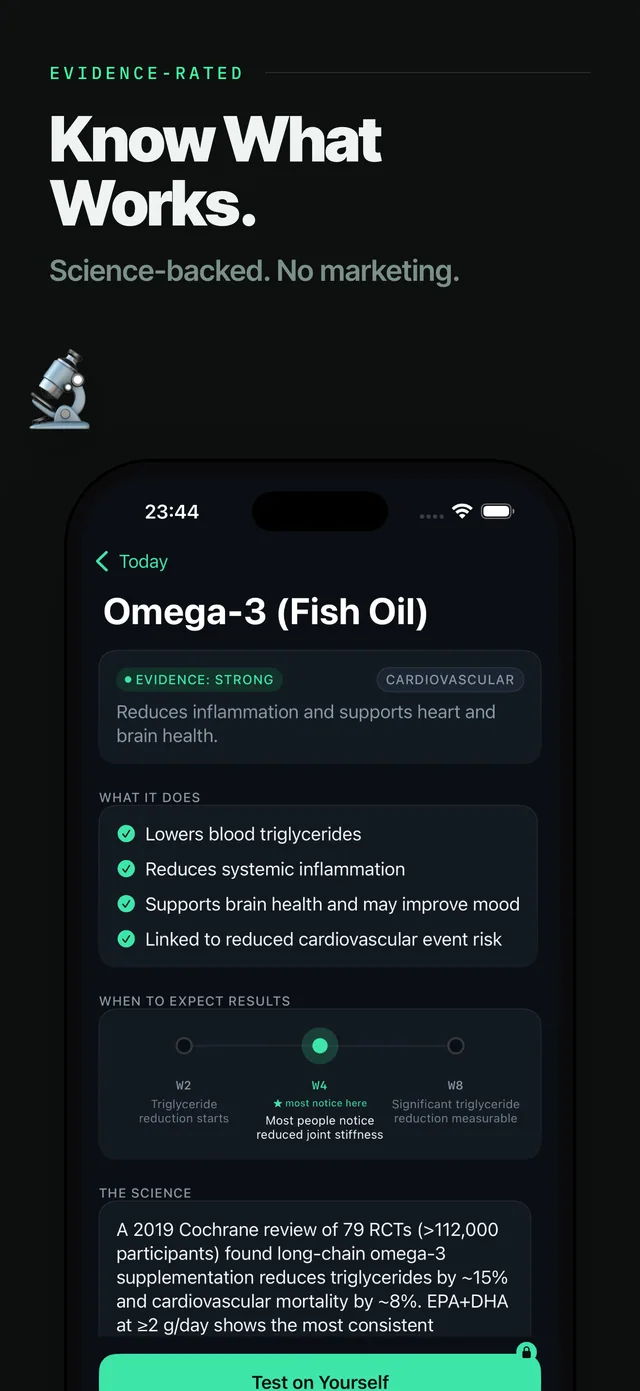
Some supplements act within hours; others need weeks. Testing a slow-acting supplement with alternating days will not show an effect. SuppLab's library lists an evidence grade and expected onset for each supplement, so you can decide whether a take/skip experiment makes sense.
4. Randomize take and skip days
Deciding each day whether to take it lets your mood and plans bias the result. A random schedule removes that bias. SuppLab builds a randomized take/skip schedule and tells you each evening what to do.
5. Run it long enough
A few nights of good sleep prove little. Run the experiment for enough take and skip days that ordinary variation averages out, and keep logging even on unusual days.
6. Read the result honestly
When the experiment ends, compare your take days with your skip days. "No measurable effect" is a useful answer too: it may save you money. SuppLab shows the result as a plain-language verdict, and all data stays on your iPhone; there are no accounts or servers.
Frequently asked questions
How do I know if magnesium is working?
Decide what you expect it to change, such as sleep quality or how rested you feel, and measure that one outcome on days you take it and days you skip it. Comparing the two is more reliable than judging by feel after starting. Ask a doctor first if you take medication or have a health condition.
How long does it take for a supplement to work?
It depends on the supplement. Some act within hours, others take weeks to change anything. Check the expected onset before testing: a slow-acting supplement will not show an effect in an alternating take/skip experiment.
What is an N-of-1 trial?
A study with a single participant, in which the same person alternates between a treatment and no treatment in a planned, often randomized order, and the outcomes of the two periods are compared. It answers whether something works for that individual.
Is there an app to track supplements?
Yes. SuppLab for iPhone tracks the supplements you take and can run a randomized take/skip experiment, reading sleep and HRV from Apple Health if you allow it or using a short daily check-in. It has no accounts and keeps data on your device.
Can I tell if a B12 or iron supplement is working this way?
Not reliably by feel. Deficiencies such as low B12 or iron are diagnosed and monitored with blood tests ordered by a doctor, so use those results rather than a home experiment.