Loss Aversion, Anchoring and Status Quo Bias: Spot Them in Your Decisions
Three common cognitive biases explained with everyday examples and simple self-tests: loss aversion, the anchoring effect and status quo bias, plus how to catch them in your own choices.
Cognitive biases are systematic shortcuts in thinking that push decisions in predictable directions. Three of the best documented, studied by Daniel Kahneman, Amos Tversky and others, show up in money, work and everyday choices.
Loss aversion
Losses feel more painful than equal gains feel good; many studies suggest roughly twice as strong. Self-test: would you take a coin flip that loses $100 on tails and wins $150 on heads? Many people refuse, although the expected value is positive.
Counter it: judge the decision by its overall expected outcome, not by the possible loss alone.
Anchoring effect
The first number you see pulls later estimates toward it, even when it is irrelevant. A high "original price" makes a discount look bigger; a first salary offer frames the negotiation.
Counter it: form your own estimate before you look at someone else's number, and consider deliberately the opposite anchor.
Status quo bias
We prefer things to stay as they are, so the default option wins more often than it should: the same insurance plan, the same subscription, the same route.
Counter it: ask "if I were choosing from scratch today, would I pick this?"
Catching biases in yourself
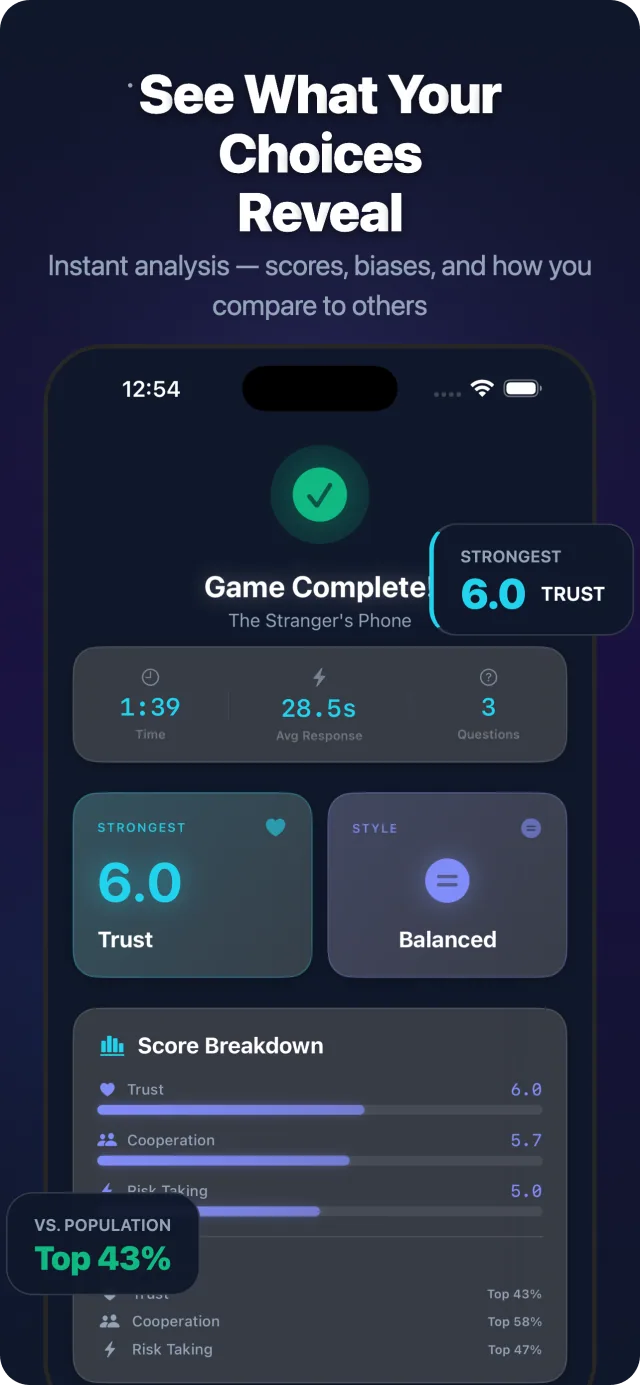
Biases are easier to see in other people. Short decision games where your choices are recorded make your own patterns visible. MindType for iPhone looks for 11 cognitive biases, including loss aversion, anchoring and status quo bias, across its game theory scenarios. It is for self-discovery and education, not a psychological assessment.
Frequently asked questions
What is loss aversion?
The tendency to feel losses more strongly than equivalent gains, which makes people avoid bets with a positive expected value.
What is an example of the anchoring effect?
Seeing a high original price makes a sale price look like a better deal, even if the original price was never realistic.
How do I avoid status quo bias?
Ask whether you would choose the current option if you were deciding from scratch today, and compare it with alternatives on equal terms.
Is there a test for cognitive biases?
Decision games that record your choices can reveal patterns. MindType for iPhone detects 11 biases across its game theory scenarios.